
Visibility Project
SEO and AI visibility put in order once: technical fixes, the missing service pages, Google Business Profile and directories. Your website stays. Afterwards the free Radar keeps watching.
from $1,490
Nobody looks on page two.
SEO for doctors means showing up on Google, on Google Maps and in ChatGPT answers wherever patients ask for your specialty. No keyword stuffing, no bought links, no number-one guarantee.
 Google
 Google Maps
 ChatGPT
 Google AI
 Bing
And what we answer.
When will I finally be at the top of Google?
When your page answers the question patients ask. On Google Maps that is often weeks, in regular search it is months. If you need appointments sooner, start ads in parallel.
An agency guaranteed us number one.
Nobody can guarantee that, not even Google. The only thing guaranteed with offers like that is the invoice.
We have a website. Why does nobody find us?
Because it usually only answers your name. Patients search by specialty, place and procedure. That takes pages of their own.
Google doesn't rank business cards. Practices that want to show up for "dermatologist Manhattan private practice" or "orthopedic surgeon NYC" need content that answers those queries directly — clinically precise, locally anchored, written for the actual searches patients are running.
A Visibility Project builds the site's content layer once: service pages per specialty, regional landing pages, structured data that signals to Google and the AI assistants who the practice is and who it treats.
It's not a content retainer. It's the substantive core of local visibility, handed over when the scope is done.
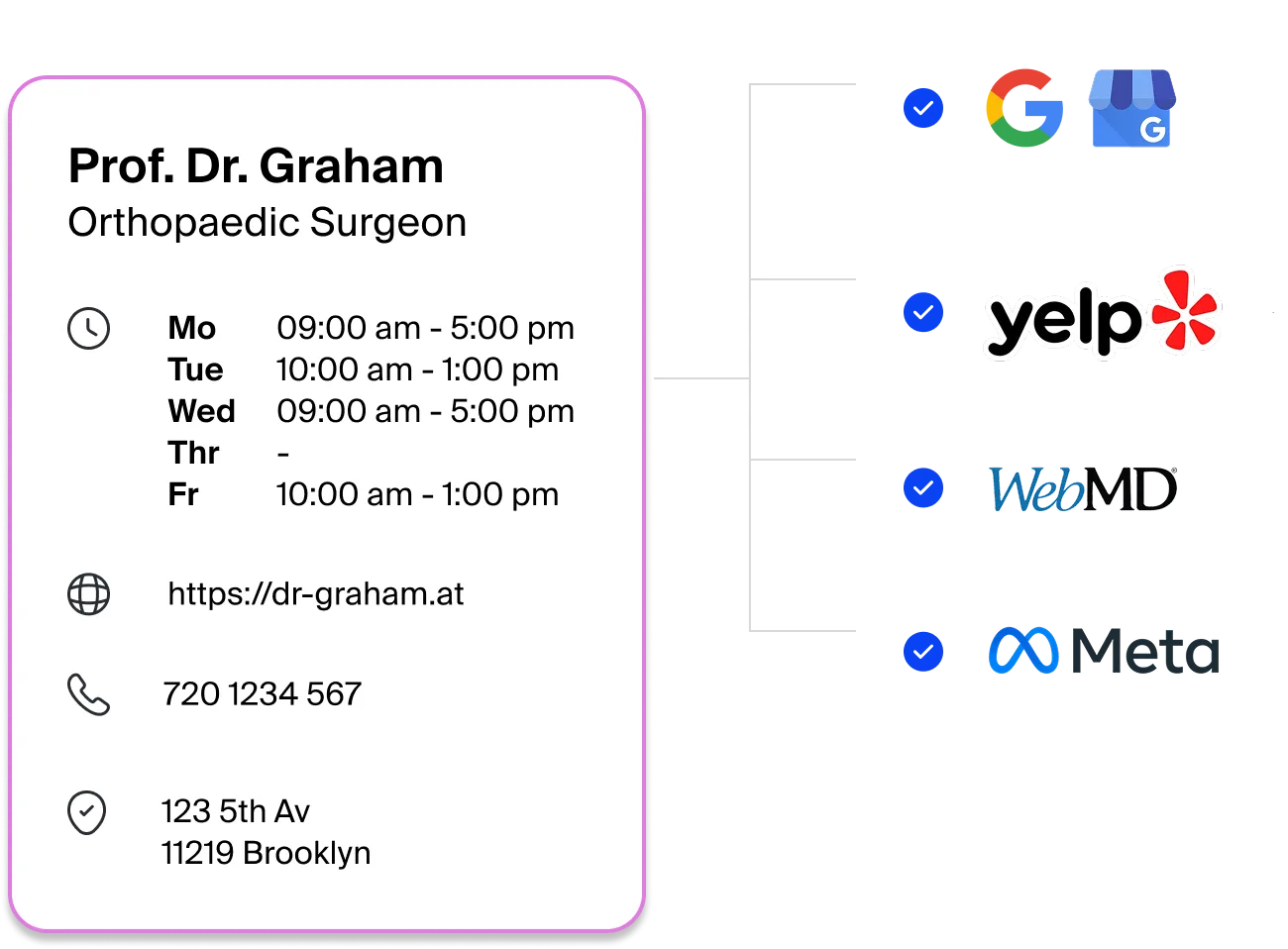
Healthgrades, ZocDoc, Vitals, WebMD, Yelp, RateMDs, Apple Maps, Bing Places — every platform has its own fields, its own requirements, its own update cycles. Inconsistent practice data is an active ranking signal working against you.
A Visibility Project covers setup and cleanup of every relevant directory entry — once, to a consistent NAP. New platforms that matter get added as part of the scope. Address, phone, and hours are aligned everywhere, not just on the website. Ongoing maintenance is not included unless you ask for it.
Seven levers. Not every one matters equally for every practice.
Which terms are actually searched near you, and which of them match your services. A selection, not a list from a tool.
Google ranks answers, not business cards. Every procedure that pays gets its own page.
Category, services, hours, photos. The profile decides whether you appear in the map pack.
Google, Yelp, WebMD, Healthgrades, Apple Maps, Bing Places. The same address and phone everywhere. Conflicts count against you.
Count, recency and replies matter on Google Maps. We set up a steady, permitted flow.
Load time, mobile view, clean structure and markup for physicians and the practice. Invisible, but measurable.
ChatGPT, Gemini and Google AI answers name practices whose pages explain and whose data is consistent everywhere. We measure in Radar whether yours is named.
Every specialty is searched differently. Here is what that looks like.
The implant case, the aligner shopper, the family on a PPO.
Injectables, lasers — and the medspa next door.
Premium lenses, LASIK shoppers, retina referrals.
Parents comparing consults, adults comparing kits.
Months of research, or an injury this week.
The operation they type, then your name.
Whoever searches "orthopedic surgeon near me" first sees a map with three practices, and only then the websites. For most practices that map spot matters more than number one in regular results.
Google names three factors: relevance, distance and prominence. Distance cannot be changed. Relevance comes from category, services and website. Prominence from reviews, directories and links. Those two are what we work on.
Not by a 40-page PDF. In the Radar dashboard you see where your practice stands for your search terms on Google, in the map pack and in AI answers, and how that changes.
And in the end by the one number that counts: more calls and appointment requests from the patients you want.
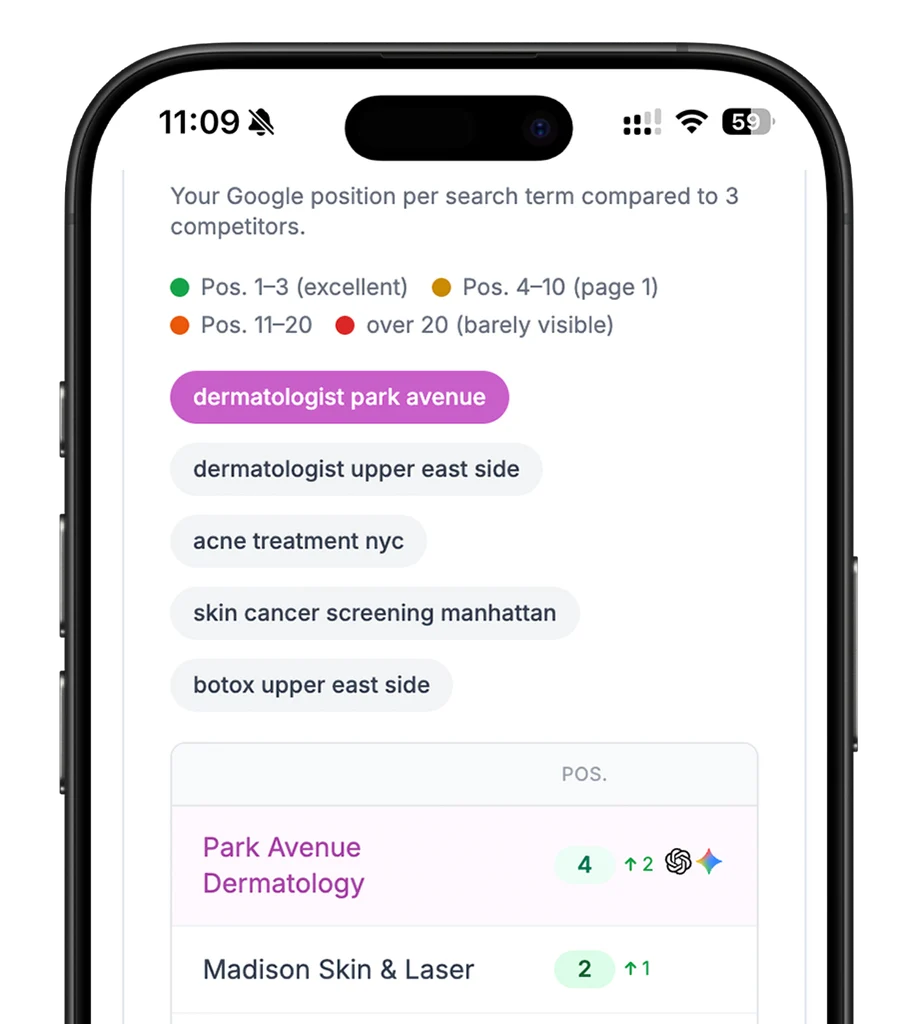
Your most relevant searches on Google, next to three practices nearby
Whether ChatGPT and Google AI name you when patients ask
Google, Yelp, and WebMD — correct, complete, and consistent
Volume, rating, and whether new reviews get an answer
Fix it once, no SEO retainer. Afterwards Radar keeps watching for free.
SEO and AI visibility put in order once: technical fixes, the missing service pages, Google Business Profile and directories. Your website stays. Afterwards the free Radar keeps watching.
Built for Google and AI answers, one page per service. Compact with one page, or a practice site with up to eight.
Website, Google profile, directories, rankings. What the audit shows, plus what it does not.
Which levers are worth it and what it costs. Binding before we start.
Profile, listings, pages, technical fixes. We agree the copy with you.
Rankings and map positions keep running in Radar. You see what moves.
30 minutes. Online. No obligation.
Answered briefly.
SEO for a practice is almost always local: patients search "specialty + place", and Google shows three practices on the map first. Local SEO means your Google Business Profile, directories and website show the same data, and every procedure has a page of its own.
First movement on Google Maps often within weeks, in regular search results more like months. If you need inquiries sooner, combine it with Google Ads.
Ads bring visibility from day one, as long as you pay. SEO builds something that stays. For most practices the answer is: both at first, fewer ads later.
Because the work happens once: profile, listings, pages, technical fixes. Afterwards you do not pay every month for reports. Radar keeps watching rankings and AI visibility for free, and if something slips, we tell you.
Whether ChatGPT, Gemini or Google's AI answer names your practice when patients ask for a doctor in your specialty. It rests on the same foundations as SEO: pages that explain, consistent data, reviews. We measure it in Radar.
No. Bought links are a risk for your practice, not a lever. Our links come from directories, partnerships and content worth linking to.
In September 2026 we scored 181 orthopedic practices in New York. Of the ones we could measure, 51% missed the Map Pack on every core search. This is the SEO that still works: the procedure, the body part, and each surgeon's own Google profile.
Dermatology is one of the most competitive medical specialties in local search. It is also one of the most rewarding to optimize for. The reason comes down to a unique characteristic that most other specialties do not share: dermatology practices serve two fundamentally different patient populati...
A patient asks ChatGPT: "Who are the best dermatologists near me for acne treatment?" The AI generates a response. It names three practices, summarizes their specialties, and links to their websites. Your practice is not on the list.